
Short answer: Manitoba law gives condo buyers real protections that many people don't know they have — a 7-day cooling-off period after receiving the required disclosure documents, a legal

Dated: August 18 2026
Views: 33
Short answer: renting a comparable 3-bedroom house in Winnipeg runs roughly $2,050–$2,075 a month, while buying the 2026 average detached home ($477,313) costs somewhere between $2,880 and $3,350 a month all-in, depending on your down payment. On pure monthly cash flow, renting is cheaper today. But that's not the whole story — buying builds equity with every payment and locks in your housing cost against future rent increases. Here's the real math, not just the sales pitch.
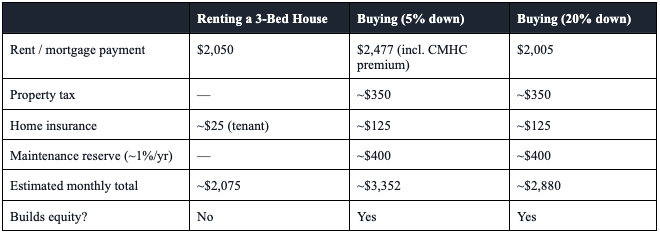
These are planning estimates based on 2026 average Winnipeg detached home pricing and current mortgage rates (roughly 3.99% on a 5-year fixed) — your actual numbers will vary by property, lender and school division. Property tax and maintenance figures are annual estimates converted to a monthly average.
Beyond the monthly comparison, buying requires real cash upfront that renting doesn't: a down payment (5% minimum on a home under $500,000) plus closing costs of roughly 1.5%–4% of the purchase price. For the full breakdown of down payment tiers, CMHC premiums and closing costs, see our companion article, How Much Does It Cost to Buy a House in Winnipeg? That upfront capital is the biggest practical barrier to buying, even when the monthly math is close.
One widely used shortcut for comparing markets is the price-to-rent ratio — a home's price divided by its annual rent. The general rule of thumb: a ratio under 15 usually favours buying, 15 to 20 is a genuine grey zone where the right answer depends on your timeline, and above 20 usually favours renting.
Winnipeg's ratio, using the 2026 average detached home price and average 3-bedroom rent, works out to roughly 19.4 ($477,313 ÷ $24,600 in annual rent) — squarely in that grey zone, leaning toward the higher end. That means buying isn't an automatic financial win here the way it might have been a few years ago, but Winnipeg still looks far more balanced than Canada's priciest markets, where ratios above 30 make renting the clearer financial choice.
Because buying involves real transaction costs — closing costs going in, and realtor commission plus legal fees coming out — the math rarely favours buying if you're not planning to stay for a while. As a general guideline, a timeline of 7 or more years tends to favour buying, since you have time to absorb those transaction costs and benefit from equity growth. A timeline under 3 years tends to favour renting, since you likely wouldn't recoup the upfront and transaction costs before selling again. Anywhere in between comes down to your specific numbers, risk tolerance, and how much you value the stability of ownership.
On a pure monthly cash-flow basis, renting is currently cheaper — roughly $2,075 a month for a comparable 3-bedroom house versus $2,880–$3,352 a month to own the 2026 average detached home, depending on down payment. Buying still builds equity that renting doesn't, which changes the picture over a longer timeline.
A price-to-rent ratio under 15 generally favours buying, 15 to 20 is a grey zone where the decision depends on your timeline and goals, and above 20 generally favours renting. Winnipeg currently sits around 19.4, comparatively balanced next to Canada's most expensive markets, where ratios often exceed 30.
As a general rule of thumb, plan to stay at least 5 to 7 years to comfortably absorb closing costs and eventual selling costs (realtor commission, legal fees) and come out ahead of renting. Shorter timelines make renting the more financially conservative choice in most cases.
Buying typically builds more home-related wealth over a long timeline through equity paydown and potential appreciation, especially with a fixed-rate mortgage locking in costs while rents rise. Renting can build comparable or greater overall wealth if the money that would have gone to a down payment and ownership costs is consistently invested elsewhere — the outcome depends heavily on discipline and market performance, not just the housing decision alone.
General averages are a starting point, not a decision. Royce Finley & Associates can walk through the real numbers for your budget, timeline and target neighbourhood — reach out to our team for a clear-eyed comparison before you decide which way makes sense for you.

I established my real estate career in 2015. I stay ahead of the curve in technology, marketing, and business development, while continuing to grow, to give my clients the best service and support pos....
Short answer: Manitoba law gives condo buyers real protections that many people don't know they have — a 7-day cooling-off period after receiving the required disclosure documents, a legal
Short answer: a legal secondary suite in Winnipeg typically costs $40,000 to $85,000+ to build (more if your basement needs underpinning), and can realistically rent for $1,000 to $1,500 a month
Short answer: renting a comparable 3-bedroom house in Winnipeg runs roughly $2,050–$2,075 a month, while buying the 2026 average detached home ($477,313) costs somewhere between $2,880 and $3
Short answer: if off-leash access matters most, look toward the city's north end near Little Mountain Park (160 acres of woodland and open space) or Kilcona Park (the city's largest off-leash area).